Guide for UK parents
EBSA Assessment: What It Is and What It Can Establish
Parents are often told their child needs “an EBSA assessment”, without being told what that means or what it can actually establish.
This guide explains what an exploration of EBSA may consider, who may contribute, and how it differs from a Support Plan, an EHCP and a medical or psychological assessment.
On this page
There is no single standardised EBSA assessment
EBSA assessment is not one nationally standardised clinical assessment. There is no single test, score or agreed national process, and what happens varies between local areas, schools and services.
EBSA describes a pattern: emotional distress or reduced capacity making school difficult to attend or remain in. It is not a medical or psychological diagnosis.
For that reason, it is often more accurate to talk about an exploration of what is happening, rather than a test with a result.
What an exploration of EBSA may consider
- Attendance patterns, including part days, late arrival and early collection.
- Emotional symptoms before, during and after school.
- Physical symptoms connected to stress.
- Masking and hidden distress.
- Sensory needs.
- Communication needs.
- Learning needs and lesson demands.
- Relationships with staff and peers, and whether the child feels safe.
- Bullying or fear of bullying.
- Transitions, changes and unstructured times.
- Recovery time after school.
- The child’s own views and words.
Attendance tells us whether a child was physically present. It does not tell us what it took for them to get there, how distressed they were during the day or how long they needed to recover afterwards.
What school, educational psychology and health may contribute
- School staff, including the SENCO and pastoral staff, on what is seen across the school day.
- Parents and carers, on what happens before and after school and over time.
- The child, on what feels hardest and what would help.
- Educational psychology, where involvement is arranged, on learning, emotional needs and the environment.
- Health professionals, where physical or mental health is involved.
- Other professionals already working with the family, where relevant.
What is available varies between areas and schools. Involvement from any particular professional cannot be promised here.
Assessment, Support Plan, EHCP and medical assessment
An assessment or exploration gathers information and understanding about what is happening for the child.
An EBSA Support Plan is the written, shared plan that follows: what the child finds difficult, what will be tried, who is responsible and how the impact will be reviewed. It is agreed with the family and the child and is not a legal document.
An EHCP needs assessment is a statutory local authority process that may lead to an Education, Health and Care plan, a legal document with its own process, timescales and rights of appeal. It is separate from any EBSA exploration, and its outcome depends on the child’s circumstances and the local authority’s decision.
A medical or psychological assessment is carried out by a qualified health professional and may lead to a diagnosis. That is a separate process from anything a school does.
What it can and cannot establish
It may help establish
- A clearer description of when and where difficulty appears.
- Patterns over time that single incidents hide.
- Which demands appear to reduce the child’s capacity.
- What the child says about their own experience.
- What has already been tried, and what happened.
- What may be worth trying next, and how it will be reviewed.
It does not establish
- It does not diagnose a medical or psychological condition.
- It does not prove the cause of a child’s distress.
- It does not decide whether an EHCP will be issued.
- It does not decide a school placement.
- It does not guarantee a reduced timetable, EOTAS or any other arrangement.
What is an EBSA Support Plan?
An EBSA Support Plan turns understanding into agreed action. It records what the child finds difficult, what is being tried, who is doing what, and when the impact will be reviewed.
EBSA-Simplified Support is the practical tool for recording patterns, attendance, emotional impact and next steps, and for building a Support Plan from what you have recorded.
Other EBSA guides for parents
- School refusal or EBSA?
The difference between attendance difficulty, emotional distress and a child’s capacity to cope.
- Masking and school anxiety
Why a child may seem fine at school and fall apart at home, and what that can cost them.
- When your child cannot attend school
School refusal and school avoidance support: what to record, what to ask school, and how to ask for a meeting.
- EBSA support for parents
What EBSA means, what to do next, and when school, educational psychology, health or local authority involvement may be relevant.
Or see the full list of EBSA guides for parents.
Further reading and support
The Unmasking EBSA book
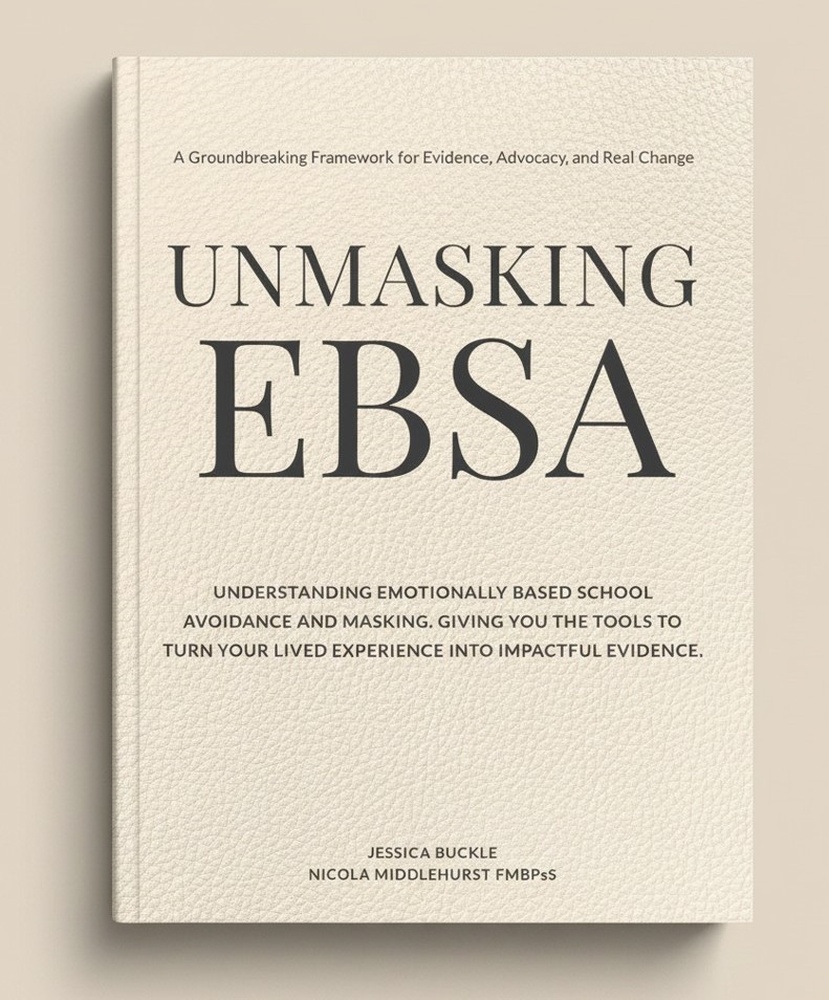
Read Unmasking EBSA by Jessica Buckle MABP and Nicola Middlehurst FMBPsS for the fuller practical guide.
Buy the bookThe Unmasking EBSA companion platform
If you already have the book, use the companion to record, organise and use what you notice.
I already have the bookEBSA-Simplified Support
The practical tool for recording patterns, attendance, emotional impact and next steps, including an EBSA Support Plan.
Visit EBSA-Simplified SupportBook-Simplified Support
Book personalised support if your family needs to talk something through with someone.
Book personalised supportWritten by Jessica and Nicola
Written by Jessica Buckle MABP and Nicola Middlehurst FMBPsS.
Jessica and Nicola are the authors of Unmasking EBSA, a practical guide for understanding emotionally based school avoidance, masking and the support children may need when school becomes difficult to access.
FAQs
What is an EBSA assessment?
There is no single nationally standardised clinical EBSA assessment. It is better described as an exploration: a structured way of gathering information about when and where a child finds school difficult, what may be reducing their capacity, what the child says about it and what has already been tried. It is not a formal medical diagnosis.
Is EBSA a diagnosis?
No. EBSA is a description of a pattern, not a formal medical or psychological diagnosis. A child may also have diagnosed conditions, or none, and still experience emotionally based school avoidance.
Who carries out an EBSA assessment?
There is no single national process. Information may be gathered by school, by parents, by the child, and where involvement is arranged, by educational psychology or health professionals. What happens depends on the local area and the child’s circumstances.
Does an EBSA assessment lead to an EHCP?
Not automatically. Information about a child’s distress, attendance and access to learning may be relevant to an EHCP needs assessment, but whether an EHCP is issued is a separate decision made by the local authority based on the child’s circumstances.
What is the difference between an EBSA assessment and an EBSA Support Plan?
An assessment or exploration gathers understanding. An EBSA Support Plan is the written, shared plan that follows: what a child finds difficult, what is being tried, who is responsible and how the impact will be reviewed. The plan is agreed with the family and the child and is not a legal document.
Can parents gather this information themselves?
Yes. Much of the most useful information about mornings, recovery time, physical symptoms and a child’s own words can only come from home. Recording it clearly gives professionals something concrete to work with.