Guide for UK parents
School Refusal and School Avoidance Support for Parents
If your child cannot attend school, or can only attend at great emotional cost, you are not looking at a discipline problem. You are usually looking at distress, reduced capacity or an unmet need.
This guide explains what school refusal and school avoidance support can look like, what parents can record, and what school may need to consider.
On this page
If your child cannot attend school
Start with understanding, not pressure. A child who cannot attend school is telling you something about how school currently feels to them, even when they cannot explain it in words.
Useful first steps are to keep your child safe and regulated, record what you are seeing before, during and after school, tell school what is happening, and ask for a meeting to look at the barriers together. Support works better when everyone is trying to understand the same picture.
Why “school refusal” can be misleading
The phrase is widely used, but it can point adults in the wrong direction:
- A child may want to attend school and still be unable to manage it.
- The wording places attention on the child’s behaviour rather than the barrier.
- It can suggest a choice where there is reduced capacity.
- It does not describe what is making school difficult.
- It can hide the level of distress a child is holding.
- It can make families feel blamed rather than involved.
Emotional distress and reduced capacity
Capacity is the amount a child can manage before they are overwhelmed. It changes day to day, and it is used up by things adults may not see: noise, uncertainty, social demands, reading a room, holding in distress, or simply getting through a lesson that feels too hard.
When capacity is low, ordinary demands can feel impossible. That is not refusal. It is a child who has run out of what it takes to cope.
Attendance tells us whether a child was physically present. It does not tell us what it took for them to get there, how distressed they were during the day or how long they needed to recover afterwards.
What may be involved
There is rarely one single cause. Adults may need to consider several of the following together:
- Anxiety and fear.
- Sensory needs and sensory overload.
- Communication needs.
- Learning needs and unidentified special educational needs.
- Neurodivergence.
- Relationships with staff or other pupils.
- Bullying or fear of bullying.
- Transitions, changes and unstructured times.
- Workload, homework and lesson demands.
- Previous negative or frightening experiences at school.
- Physical symptoms connected to stress.
- Attendance pressure and repeated failed returns.
This list is not a diagnosis and it is not a checklist to score. It is a prompt to look carefully at your child’s individual circumstances.
What parents can record
Short notes made regularly are more useful than long notes made rarely.
Before school
- How the evening and night before went, including sleep.
- What happens on waking.
- Physical symptoms such as nausea, headaches or stomach pain.
- What the child says about school, in their own words.
- What happens during the journey and at the school gate.
During school
- Whether the child entered the building.
- How much of the day they managed.
- Lessons, places, times or people that appeared harder.
- Whether the child was able to ask for help.
- Anything school tells you about the day.
After school
- What happens in the first hour at home.
- How long recovery takes.
- Distress, shutdown, exhaustion or withdrawal.
- The effect on eating, sleeping and family life.
- What helped, even briefly.
The aim is not to build a case against school. The aim is to build an accurate picture of what your child is experiencing.
What school may need to consider
Parents can ask school to look beyond attendance and consider:
- What the child finds hardest across the whole day.
- Whether sensory, communication or learning needs have been identified.
- Whether masking may be hiding the level of difficulty.
- Adjustments that could be tried and reviewed.
- Safe places, safe adults and a way to ask for help.
- Arrival, transitions, break and lunch.
- What happens if the child arrives but cannot stay.
- How the child’s views will be gathered.
- How the emotional impact of support will be reviewed, not only attendance.
It can help to frame the conversation through the SEND graduated approach of Assess, Plan, Do and Review. Where the Equality Act 2010 applies, a school may also need to consider reasonable adjustments for a disabled child. What is appropriate depends on the child’s circumstances, and no particular adjustment, timetable change or placement can be guaranteed.
The child’s voice
A child’s own words carry weight. They can be offered gently, at a calm moment, and a child does not have to give a tidy explanation for anyone.
- What is the hardest part of the school day?
- When does school first start to feel difficult?
- What happens in your body when it feels too much?
- Are there times you feel you have to hide how you are feeling?
- What would make school feel safer or more manageable?
- What do you wish adults understood?
Drawing, writing, messaging or choosing from options can all count. So can silence about something that is still too hard to talk about.
Attendance, late arrival and early collection
Part days matter. A child who arrives late, leaves early, spends time outside the classroom, or is collected partway through the day is still telling you something important.
Recording those details alongside distress and recovery time gives a fuller picture than an attendance percentage alone. It can also show progress that a percentage would hide, such as a calmer morning or a shorter recovery.
How parents can request a collaborative meeting
- 1Ask in writing for a meeting to look at barriers and support together.
- 2Say who you would like there, such as the SENCO or pastoral lead.
- 3Share what you have recorded before, during and after school.
- 4Include your child’s own words, and their views on what would help.
- 5Ask what school can try, and what they need from you.
- 6Agree in writing what will be tried, by whom and by when.
- 7Agree how the emotional impact will be reviewed, and when you will meet again.
When further advice may be needed
If distress or attendance difficulties continue, it may be appropriate to seek further SEND, educational, health or legal advice. That might include your GP, the school’s SENCO, the local authority, educational psychology involvement, or independent advice about your child’s rights and your own responsibilities.
Asking for advice is not an admission that something has gone wrong at home. It is a reasonable step when a child cannot access education safely.
What is an EBSA Support Plan?
An EBSA Support Plan is a written, shared plan describing what a child finds difficult, what is being tried, who is responsible and how the impact will be reviewed. It is agreed with the family and the child. It is not a legal document and it is not the same as an EHCP.
EBSA-Simplified Support is the practical tool for recording patterns, attendance, emotional impact and next steps, and for building a Support Plan from what you have recorded.
Other EBSA guides for parents
- School refusal or EBSA?
The difference between attendance difficulty, emotional distress and a child’s capacity to cope.
- Masking and school anxiety
Why a child may seem fine at school and fall apart at home, and what that can cost them.
- EBSA support for parents
What EBSA means, what to do next, and when school, educational psychology, health or local authority involvement may be relevant.
- EBSA assessment
What an EBSA assessment or exploration may consider, and what it can and cannot establish.
Or see the full list of EBSA guides for parents.
Further reading and support
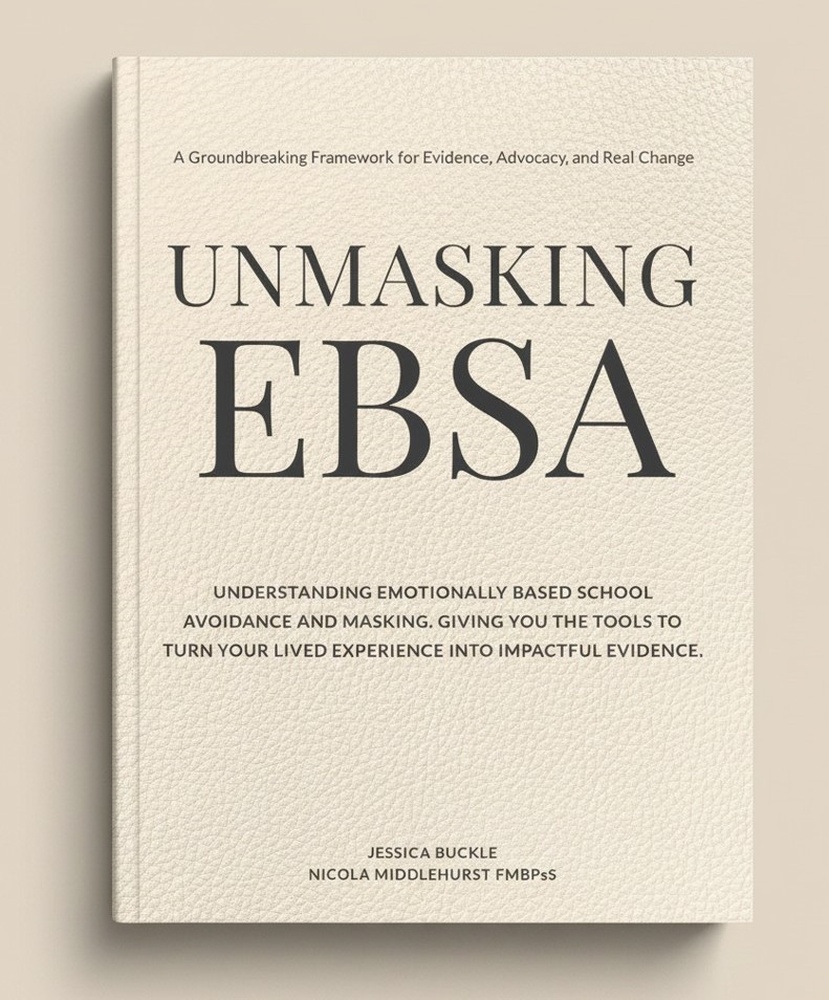
The Unmasking EBSA book
Read Unmasking EBSA by Jessica Buckle MABP and Nicola Middlehurst FMBPsS for the fuller practical guide.
Buy the bookThe Unmasking EBSA companion platform
If you already have the book, use the companion to record, organise and use what you notice.
I already have the bookEBSA-Simplified Support
The practical tool for recording patterns, attendance, emotional impact and next steps, including an EBSA Support Plan.
Visit EBSA-Simplified SupportBook-Simplified Support
Book personalised support if your family needs to talk something through with someone.
Book personalised supportWritten by Jessica and Nicola
Written by Jessica Buckle MABP and Nicola Middlehurst FMBPsS.
Jessica and Nicola are the authors of Unmasking EBSA, a practical guide for understanding emotionally based school avoidance, masking and the support children may need when school becomes difficult to access.
FAQs
What support is there for school refusal?
Support usually starts with understanding why school has become difficult. That can include recording what happens before, during and after school, sharing this with school, asking for a collaborative meeting, considering unmet needs and reasonable adjustments, and agreeing what will be tried and how the impact will be reviewed. Further SEND, educational, medical or legal advice may be needed if difficulties continue.
My child cannot attend school. What should I do first?
Try to keep your child safe and regulated first, then record what you are seeing, including physical symptoms, distress, recovery time and your child’s own words. Contact school, explain what is happening and ask for a meeting to look at the barriers together rather than focusing only on attendance.
Is school attendance anxiety the same as EBSA?
They overlap but are not identical. School attendance anxiety describes anxiety connected to attending school. Emotionally based school avoidance describes a pattern where emotional distress or reduced capacity makes attending or remaining in school difficult. The child’s individual circumstances need to be understood.
Can school insist my child attends full time?
Schools have attendance duties and parents have legal responsibilities, so it is important to keep school informed and to seek advice about your own situation. Whether any change to the school day can be agreed depends on the child’s circumstances and the decisions of the school and local authority. No particular arrangement can be promised here.
Should I ask for a reduced timetable?
You can ask school to consider whether the current school day is realistic for your child’s capacity, and what adjustments might help. A reduced timetable is not something a school must agree to, and it is not suitable for every child. It should only ever be time limited, agreed and reviewed.
Does recording what happens mean I am building a case against school?
No. The aim of recording is to build an accurate picture of what your child is experiencing so that adults can respond to the right thing. Many families find that clear, calm information makes conversations with school easier rather than harder.