Guide for UK parents
Is school refusal the same as emotionally based school avoidance?
No. “School refusal” and emotionally based school avoidance are not automatically the same thing.
“School refusal” is often used to describe a child who is finding it difficult to attend school. However, the phrase can sound as though a child is simply choosing not to go or deliberately refusing. Emotionally based school avoidance describes the emotional distress, anxiety, overwhelm or reduced capacity that may be making school difficult to access.
Not every attendance difficulty is EBSA, and EBSA is not a diagnosis in itself. The child’s individual circumstances need to be understood.
On this page
Why the phrase “school refusal” can be misleading
The phrase “school refusal” is still used in many conversations about attendance. It can be a shorthand, but it needs care. Language should not replace a thoughtful look at the child’s needs and the reasons school has become hard to access.
- A child may not be refusing school in the ordinary meaning of the word.
- The child may want to attend but be unable to manage the emotional, sensory, social or learning demands.
- The wording can place attention on behaviour rather than the reason attendance has become difficult.
- A child may attend some days and still experience significant distress.
- A child may appear calm or compliant in school and then become distressed, exhausted or overwhelmed at home.
- Using the phrase does not tell us what is causing the difficulty.
This does not mean the phrase must never be used. It means adults need to be clear that the wording does not, by itself, explain what is happening for the child.
What is emotionally based school avoidance?
Emotionally based school avoidance, often shortened to EBSA, is a pattern of difficulty attending or remaining in school because of emotional distress. The distress may be connected to anxiety, sensory needs, communication difficulties, learning demands, relationships, bullying, trauma, transitions, a lack of belonging or other unmet needs.
The behaviour adults see may be the final part of a much bigger process. A child may have been trying to manage for a long time before attendance becomes visibly difficult.
EBSA is not the same as truancy. It is not automatically caused by poor parenting, and it is not a formal diagnosis by itself. The same child may experience more than one pathway, including anxiety led, capacity led or trauma and relational difficulties.
Attendance does not show the whole picture
Attendance tells us whether a child was physically present. It does not tell us what it took for them to get there, how distressed they were during the day or how long they needed to recover afterwards.
There is an important difference between being present and being able to cope. Attendance remains important, but attendance figures alone cannot explain a child’s needs.
- A child attending while masking distress.
- A child attending but being unable to learn.
- A child arriving late because the morning routine has become overwhelming.
- A child leaving early or being collected.
- A child attending for a short period and then losing capacity.
- A child appearing fine at school and falling apart at home.
Why distress should be understood before attendance is increased
Increasing attendance without understanding the barrier may:
- Increase anxiety.
- Reduce trust between the child and adults.
- Make the child’s distress more severe.
- Lead to repeated failed attempts.
- Make recovery take longer.
- Create a cycle of attendance, overwhelm and further absence.
This does not mean attendance should be ignored. It means any attendance plan should be based on understanding the child, identifying barriers, agreeing support and reviewing whether the plan is helping.
The question should not only be, “How do we get this child back into school?”
It should also be, “What is making school feel impossible, and what needs to change so that the child can access education safely and sustainably?”
What may be behind the difficulty?
Parents and school may need to consider a range of possible barriers. This is not a diagnostic list, and it does not mean every child will have all of these difficulties.
- Anxiety and fear.
- Sensory overload.
- Communication difficulties.
- Learning needs.
- Unidentified special educational needs.
- Neurodivergence.
- Transitions and changes in routine.
- Lessons, homework or workload.
- Unstructured times such as lunch and break.
- Relationships with staff or other pupils.
- Bullying or fear of bullying.
- Trauma or previous negative experiences.
- Attendance pressure and repeated failed returns.
- Physical symptoms connected to stress.
What can parents record?
Recording can help turn a series of difficult days into a clearer picture. Parents can record:
- What happens the night before school.
- What happens on waking.
- Physical symptoms.
- What the child says about school.
- What happens at the school gate.
- Whether the child enters the building.
- Whether the child stays for the full day.
- Whether the child needs to leave early.
- What happens after school.
- How long recovery takes.
- What helps, even briefly.
- The child’s own words.
The purpose of recording is not to build an argument against school. It is to create a more accurate picture of the child’s experience so that support can be planned properly.
What can parents ask school to consider?
These questions can help keep the conversation focused on needs, barriers and what support should be tried:
- What does the child find hardest?
- Are there particular lessons, places, times or people that increase distress?
- Is the child able to ask for help?
- Could masking be hiding the level of difficulty?
- Are sensory, communication or learning needs being considered?
- What adjustments could be tried?
- How will the child’s views be gathered?
- How will the impact of support be reviewed?
- Is the current timetable realistic for the child’s capacity?
- What will happen if the child arrives but cannot remain for the full day?
It can help to use the SEND Code of Practice graduated approach: Assess, Plan, Do and Review. Where the Equality Act 2010 applies, the school may also need to consider reasonable adjustments for a disabled child.
There are no automatic legal promises. A school does not always have to agree to a reduced timetable, and any temporary arrangement should be carefully planned, recorded and reviewed.
What should happen next?
- 1Listen to the child without assuming the cause.
- 2Record patterns before, during and after school.
- 3Share the information with school.
- 4Ask for a collaborative meeting.
- 5Ask school to consider unmet needs and reasonable adjustments.
- 6Agree what support will be tried.
- 7Agree how progress and emotional impact will be reviewed.
- 8Seek further SEND, educational, medical or legal advice if the difficulties continue.
School refusal, EBSA and the child’s voice
The child’s own experience should be included wherever possible. Some children can explain what is happening; others need time, visuals, choices, or a trusted adult to help them communicate.
- What is the hardest part of school?
- When does school first start to feel difficult?
- What happens in your body when you feel overwhelmed?
- Are there times when you feel you have to hide how you are feeling?
- What would make school feel safer or more manageable?
- What do you wish adults understood?
Children should not be pressured to provide a perfect explanation immediately. Their words, behaviours, body language and recovery time can all help adults understand the wider picture.
The short answer
- School refusal and EBSA are not automatically the same.
- “School refusal” describes an attendance difficulty but can sound as though the child is making a simple choice.
- EBSA focuses on the emotional distress and reduced capacity that may sit underneath the difficulty.
- The right response is to understand the barrier, listen to the child, consider support and review what happens next.
Further reading and support
Masking and school anxiety
Read the related guide about masking at school, hidden distress and what families can record.
Read the guideThe Unmasking EBSA book
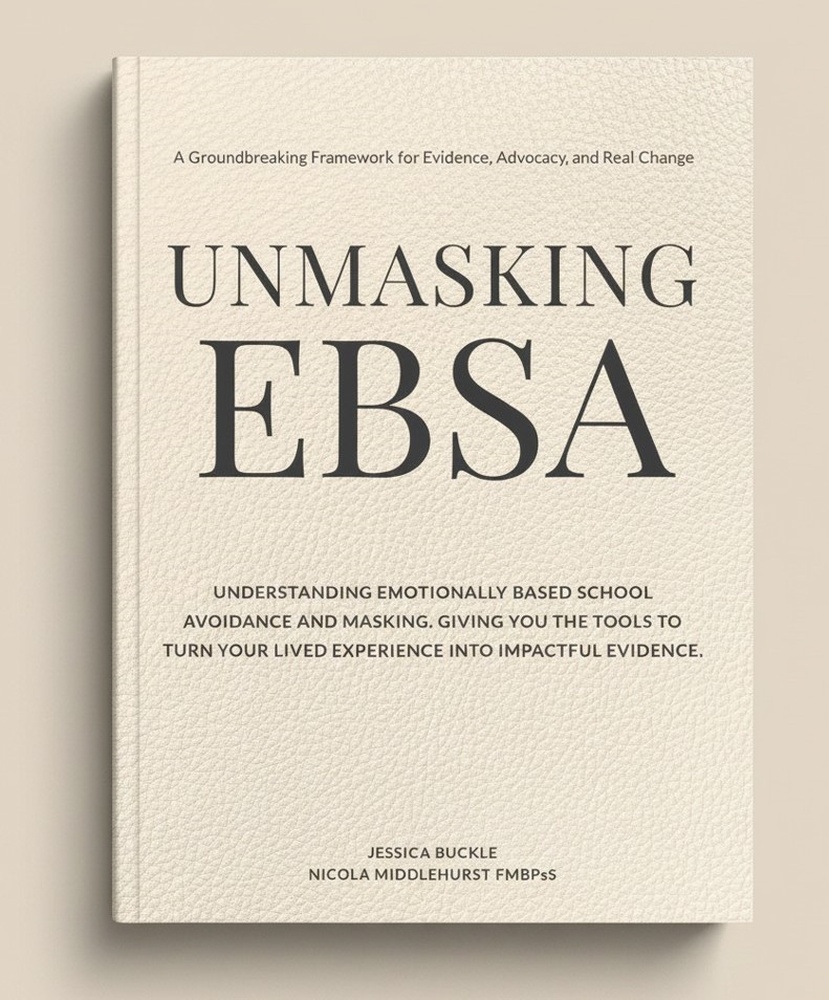
Read Unmasking EBSA by Jessica Buckle MABP and Nicola Middlehurst FMBPsS for the fuller practical guide.
Explore the bookThe companion platform
If you already have the book, use the companion to record, organise and use what you notice.
Access the companionPractical tracking and personalised support
EBSA-Simplified Support
The practical tool for tracking patterns, attendance, emotional impact, evidence and an EBSA Support Plan.
Visit EBSA-Simplified SupportBook-Simplified Support
Book personalised support with Jess if your family needs to talk something through.
Book personalised supportOther EBSA guides for parents
- Masking and school anxiety
Why a child may seem fine at school and fall apart at home, and what that can cost them.
- When your child cannot attend school
School refusal and school avoidance support: what to record, what to ask school, and how to ask for a meeting.
- EBSA support for parents
What EBSA means, what to do next, and when school, educational psychology, health or local authority involvement may be relevant.
- EBSA assessment
What an EBSA assessment or exploration may consider, and what it can and cannot establish.
Or see the full list of EBSA guides for parents.
Written by Jessica and Nicola
Written by Jessica Buckle MABP and Nicola Middlehurst FMBPsS, authors of Unmasking EBSA.
FAQs
Is school refusal the same as EBSA?
No. School refusal and emotionally based school avoidance are not automatically the same. School refusal describes an attendance difficulty, while EBSA focuses on the emotional distress or reduced capacity that may be making school difficult to access.
Is EBSA the same as truancy?
No. EBSA is not the same as truancy. EBSA describes difficulty attending or remaining in school because of emotional distress, anxiety, overwhelm or reduced capacity. The child’s circumstances need to be understood carefully.
Can a child have EBSA if they are still attending school?
Yes, a child may still be attending school and experiencing significant distress. Attendance shows physical presence, but it does not show what it took to get there, how the child coped during the day or how long recovery took afterwards.
Can a school say that a child is refusing school?
A school may use the phrase school refusal to describe attendance difficulty, but the wording should be used carefully. It should not replace an assessment of why school has become hard to access or what support the child may need.
What should parents do if school focuses only on attendance?
Parents can calmly share what they are seeing before, during and after school, including physical symptoms, distress, recovery time and the child’s own words. They can ask for a collaborative meeting to look at barriers, support and how the impact will be reviewed.
Can EBSA be included in an EHCP?
A child’s difficulties with emotional distress, attendance, access to learning and support needs may be relevant to an EHCP process, depending on the child’s circumstances. This does not mean an EHCP will always be issued or that a particular adjustment will always be agreed.