Guide for UK parents
EBSA Support for Parents: Understanding What to Do Next
When school becomes difficult, most parents are not given a clear place to start. This guide explains what EBSA means, what you can do next, and where the practical tools sit.
It is educational. It does not diagnose your child and it does not replace medical, psychological, educational or legal advice.
On this page
What EBSA means
EBSA stands for emotionally based school avoidance. It describes a pattern where emotional distress, anxiety, overwhelm or reduced capacity makes attending or remaining in school difficult.
EBSA is not truancy. It is not a formal diagnosis. It is not caused by poor parenting. The difficulty may be anxiety led, capacity led or trauma led, and often more than one thing is happening at once.
How EBSA may present differently in different children
Two children with similar difficulties can look completely different from the outside. Possible patterns include:
- A child who becomes distressed before school but appears settled once inside.
- A child who attends and masks, then collapses at home.
- A child who attends some days and not others.
- A child who arrives late, leaves early or needs to be collected.
- A child with frequent physical symptoms connected to stress.
- A child who becomes withdrawn, quiet or shut down rather than visibly upset.
- A child whose distress appears mainly at weekends or before a new term.
- A child who says very little about school at all.
None of these prove EBSA on their own. They are reasons to look more carefully at your child’s individual circumstances.
What parents can do when a child cannot attend school
- 1Keep your child safe and regulated before anything else.
- 2Tell school what is happening, factually and calmly.
- 3Record what you see before, during and after school.
- 4Ask your child what feels hardest, without pressing for a full explanation.
- 5Ask school for a meeting to look at barriers and support together.
- 6Agree what will be tried, by whom, and how the impact will be reviewed.
- 7Seek further SEND, educational, health or legal advice if difficulties continue.
The question is not only, “How do we get this child into school?” It is also, “What is making school feel impossible, and what needs to change?”
How to record patterns and distress
Recording gives you something steady to share when conversations become difficult. Useful things to capture include:
- Attendance, part days, late arrival and early collection.
- Emotional distress before, during and after school.
- Physical symptoms.
- How long recovery takes.
- Sensory, social and learning demands that appear harder.
- Days, lessons, places or people linked to more distress.
- Your child’s own words, kept separate from adult observations.
- What helped, even briefly.
Recording is not evidence gathering against school. It is how you and school end up looking at the same picture.
How to communicate with school
- Describe what you have seen, with dates, rather than conclusions.
- Separate your child’s words from your own observations.
- Say clearly what you are asking school to consider.
- Ask for responses and agreements in writing.
- Keep a copy of what you send and what you receive.
- Ask when the support will be reviewed.
Nothing needs to be sent in anger or in a hurry. A short, factual message about what is happening and what you are asking school to consider is usually more effective than a long account written at the end of a hard day.
How the child’s voice should be included
- Ask at a calm moment, not straight after a difficult morning.
- Offer choices, drawing, writing or messaging instead of face to face questions.
- Accept partial answers and silences.
- Record their words as they said them.
- Ask what they would like adults to know, and what they would rather keep private.
A child does not have to justify their distress to be believed, and they should not be pressured into producing a perfect explanation.
When an EHCP, educational psychology or health involvement may be relevant
If difficulties continue despite adjustments, wider involvement may become relevant. That could include educational psychology advice, health services where physical or mental health is involved, or a request for an EHCP needs assessment.
None of these outcomes is automatic. Whether an assessment is carried out, and what it leads to, depends on the child’s circumstances and the decisions of the professionals and the local authority involved.
The difference between information, support planning and assessment
Information is what guides like this one give you: an explanation so you can understand what may be happening and what to look at.
Support planning is agreeing with school what will be tried, by whom, and how the impact will be reviewed. That is where an EBSA Support Plan sits.
Assessment is a professional process, such as educational psychology involvement, a health assessment or an EHCP needs assessment. It follows its own rules and timescales, and its outcome is not something a website can promise.
What is an EBSA Support Plan?
An EBSA Support Plan is a written, shared plan describing what a child finds difficult, what is being tried, who is responsible and how the impact will be reviewed. It is agreed with the family and the child, and it is not a legal document.
EBSA-Simplified Support is the practical tool for recording patterns, attendance, emotional impact and next steps, and for turning what you have recorded into a Support Plan.
Other EBSA guides for parents
- School refusal or EBSA?
The difference between attendance difficulty, emotional distress and a child’s capacity to cope.
- Masking and school anxiety
Why a child may seem fine at school and fall apart at home, and what that can cost them.
- When your child cannot attend school
School refusal and school avoidance support: what to record, what to ask school, and how to ask for a meeting.
- EBSA assessment
What an EBSA assessment or exploration may consider, and what it can and cannot establish.
Or see the full list of EBSA guides for parents.
Further reading and support
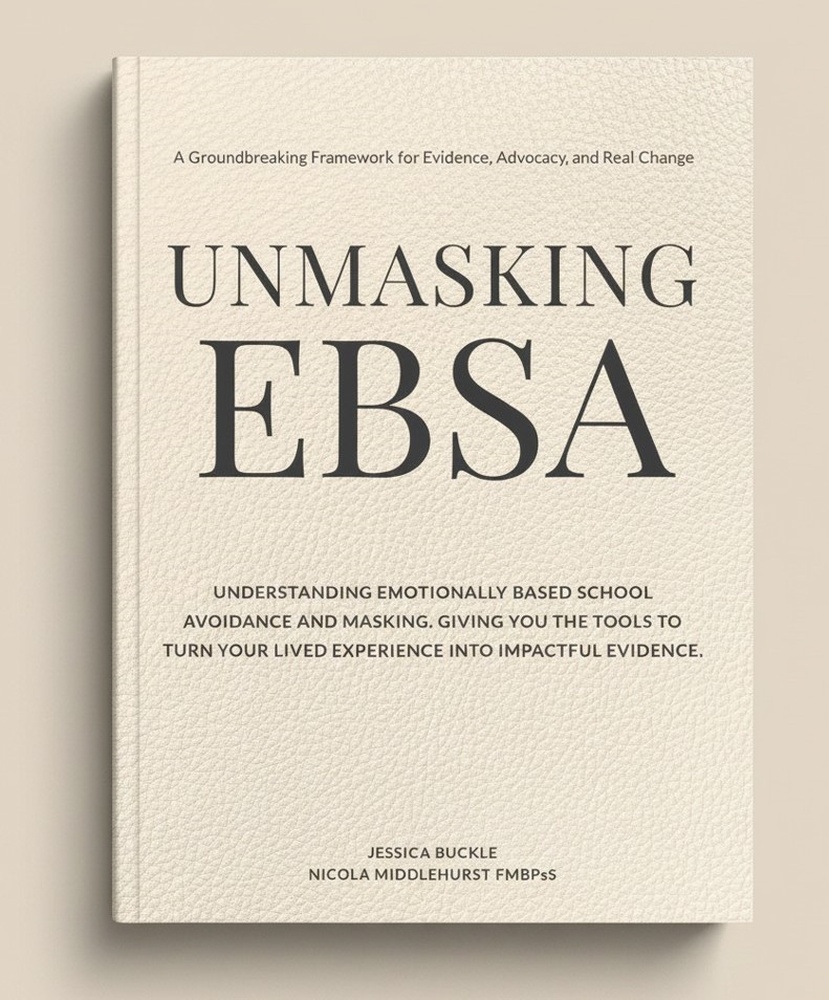
The Unmasking EBSA book
Read Unmasking EBSA by Jessica Buckle MABP and Nicola Middlehurst FMBPsS for the fuller practical guide.
Buy the bookThe Unmasking EBSA companion platform
If you already have the book, use the companion to record, organise and use what you notice.
I already have the bookEBSA-Simplified Support
The practical tool for recording patterns, attendance, emotional impact and next steps, including an EBSA Support Plan.
Visit EBSA-Simplified SupportBook-Simplified Support
Book personalised support if your family needs to talk something through with someone.
Book personalised supportWritten by Jessica and Nicola
Written by Jessica Buckle MABP and Nicola Middlehurst FMBPsS.
Jessica and Nicola are the authors of Unmasking EBSA, a practical guide for understanding emotionally based school avoidance, masking and the support children may need when school becomes difficult to access.
FAQs
What does EBSA mean?
EBSA stands for emotionally based school avoidance. It describes a pattern where emotional distress, anxiety, overwhelm or reduced capacity makes attending or remaining in school difficult. It is not truancy, it is not a formal diagnosis and it is not caused by poor parenting.
What support is available for EBSA?
Support usually involves understanding the barriers, adjusting what is being asked of the child, agreeing a plan with school and reviewing the emotional impact over time. Depending on the child’s circumstances, educational psychology, health services or a SEND assessment may also become relevant.
Does EBSA mean my child will get an EHCP?
No. Difficulties with emotional distress, attendance and access to learning may be relevant to an EHCP needs assessment, but an EHCP is never automatic. Whether one is issued depends on the child’s circumstances and the local authority’s decision.
How do I record EBSA patterns?
Record short notes regularly rather than long notes rarely. Include attendance and part days, distress before, during and after school, physical symptoms, recovery time, demands that appear harder, and your child’s own words. The Unmasking EBSA companion platform and EBSA-Simplified Support are both built for this.
Is EBSA the same as school refusal?
Not automatically. School refusal describes an attendance difficulty. EBSA focuses on the emotional distress or reduced capacity that may be making school hard to access. The wording you use can change how adults respond.
Who can help if school is not listening?
You can ask for a meeting with the SENCO or a senior leader, put your concerns in writing, and seek independent SEND advice or support from your local information and advice service. Your GP or other health professionals may also be able to contribute where physical or mental health is involved.