Guide for UK parents
Why Does My Child Mask at School and Break Down at Home?
If your child seems to cope at school but is distressed, exhausted or overwhelmed at home, masking may be part of the picture.
This guide explains what masking can look like, how it can relate to school anxiety and emotionally based school avoidance, and what parents can record and discuss with school.
Many parents describe it as: “my child seems fine at school but falls apart at home.” This page gives a careful place to start.
On this page
Why does my child mask at school and break down at home?
A child may mask at school because school feels unsafe, confusing or too demanding to show distress in, and then break down at home because home is the first place that feels safe enough to let it out. Masking uses a great deal of emotional energy, and when that energy runs out the distress has to go somewhere.
This guide explains what masking can look like, the cost of coping, why recovery takes time, and what parents can record and discuss with school. It is about masking, school anxiety and emotionally based school avoidance in UK schools.
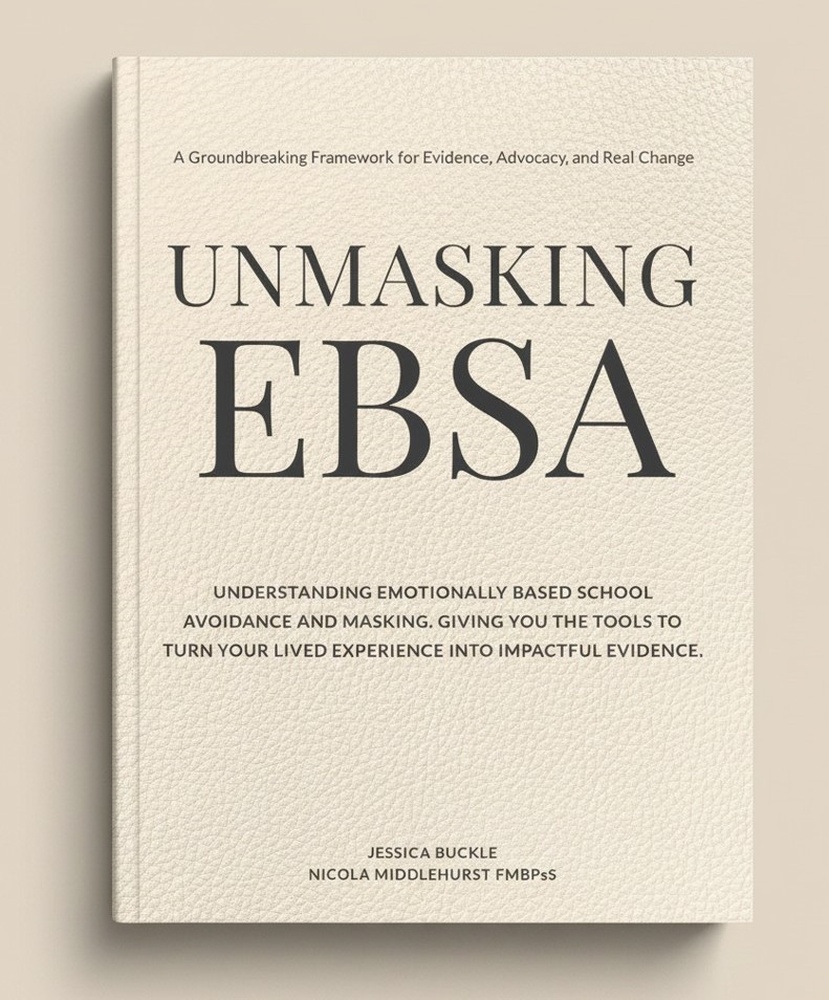
The guide is written by Jessica Buckle MABP and Nicola Middlehurst FMBPsS, authors of Unmasking EBSA. It is intended to help parents understand patterns, organise information and have more informed conversations with school. It does not diagnose a child or replace medical, psychological, educational or legal advice.
What is masking?
Masking can involve hiding, suppressing or copying in order to get through a situation. In school, a child may be trying to hide distress, sensory discomfort, confusion, communication needs or the need for help.
Masking does not mean a child is fine. It is not a diagnosis, and it is not only linked to autism. A child may not be consciously choosing to mask. They may simply have learned, over time, that appearing to cope feels safer than showing what is really happening.
Adults need to consider the cost of coping, not only what is visible in school. The question is not just, “Did they attend?” or “Were they quiet?” It is also, “What did it take for them to get through the day?”
What can masking look like in a child?
Masking at school can look different from one child to another. Possible signs may include:
- A child appearing quiet, compliant or fine in school but becoming distressed at home.
- Meltdowns, shutdowns or exhaustion after school.
- Physical symptoms before school, such as nausea, headaches or stomach pain.
- A child copying peers or avoiding asking for help.
- Difficulty explaining what happened during the school day.
- Perfectionism or fear of getting things wrong.
- Increased distress on Sunday evenings or before returning after a break.
- Sleep difficulties after a school day.
- A growing difference between school reports and what the family sees at home.
These signs do not prove masking. They should be understood alongside the child’s wider circumstances, including health, relationships, learning needs, sensory needs, communication needs and what else is happening in their life.
Masking, school anxiety and EBSA
School anxiety can be hidden. A child may attend school while experiencing significant distress, and that distress may not be obvious to every adult around them.
Emotionally based school avoidance is a pattern where emotional distress makes attending or remaining in school difficult. EBSA and masking can overlap, but they are not exactly the same thing. A child may be masking distress while still attending, or masking may be one part of a wider EBSA picture.
Attendance alone does not show whether a child is coping. Descriptions such as “school refusal”, “choosing not to attend”, “lazy”, “defiant” or “attention seeking” can be unhelpful when they stop adults looking for the barrier underneath the behaviour.
Why a child may look fine at school and fall apart at home
Sometimes home is the place where a child finally feels safe enough to release the distress they have held in during the day. This does not mean every child who struggles at home is masking, but it is one possible pattern to consider carefully.
Holding it together
A child may keep everything inside until they reach home.
No words left
They may have no energy left for conversation, homework or family life.
Small demands feel too much
Distress can appear around ordinary requests because capacity has been used up.
Recovery time matters
A child may need significant recovery time after attending school.
Why this does not prove that a child is fine
A calm report from school is real information, but it is not the whole picture. It describes what was visible to the adults who were there. It does not describe what the child was holding in, or what it cost them.
When a child appears settled in school and distressed at home, both observations are true at the same time. The task is not to decide who is right. It is to understand why the two pictures differ.
Equally, distress at home does not on its own prove that a child is masking. It is one possibility to consider alongside health, relationships, learning needs, sensory needs, communication needs and everything else happening in their life.
The emotional cost of coping
Coping is not free. Holding in distress, reading social situations, managing noise and movement, following instructions that are hard to process and hiding the need for help all use capacity.
Capacity is limited and it changes day to day. A child who spends all of it getting through the school day may have nothing left for homework, conversation, siblings or ordinary requests. Distress at home can then appear around very small things, because the small thing is not the cause.
The question is not only, “Did they attend?” It is also, “What did it take for them to get through the day?”
Recovery time after school
Recovery time is how long a child needs after school before they can manage ordinary life again. For some children this is minutes. For others it is hours, an evening, or the whole weekend.
Recovery time is worth recording, because it often changes before attendance does. A shorter recovery, or a calmer evening, can be real progress even when the attendance figure looks the same. A lengthening recovery can be an early warning that the current demands are too high.
Physical symptoms and school anxiety
Anxiety and sustained stress can produce genuine physical symptoms: stomach pain, nausea, headaches, needing the toilet urgently, dizziness, shaking, appetite changes or difficulty sleeping.
These symptoms are not made up and they are not naughtiness. They also should not be assumed to be anxiety. Physical symptoms deserve a conversation with your GP so that health causes can be considered properly alongside what is happening at school.
The child’s own words and experience
A child’s own account is some of the most important information you have. Recording it as they said it, rather than as an adult summary, keeps it accurate and gives it weight in conversations with school.
Children may not have the words yet, or may fear getting an adult in trouble, or may not know why school feels impossible. Drawing, writing, messaging or choosing from options can all help. A child does not have to produce a clear explanation to be believed.
What parents can record
Recording does not need to be perfect. A short note made regularly can help you and school see patterns that are easy to miss when every day feels urgent.
- What happens before school.
- What happens during the journey.
- What happens at the school gate.
- What the child says or does before entering.
- What happens after school.
- How long recovery takes.
- Attendance, late arrival, leaving early or being collected.
- Sensory triggers.
- Lessons, transitions, people or places that appear difficult.
- The child’s own words.
- What helps, even briefly.
The aim is not to build a case against school. The aim is to build an accurate picture of what your child is experiencing.
Questions parents can ask their child
These questions can be offered gently, at a time when the child is more regulated. They are not an interrogation, and the child does not have to answer immediately.
- What is the hardest part of the school day?
- When do you first notice that school feels difficult?
- Are there times when you feel you have to hide how you are feeling?
- What helps you get through the day?
- What happens in your body when school feels too much?
- What do you wish adults understood?
What parents can ask school to consider
Parents can ask school to look beyond attendance and consider what the child is managing across the whole day. That may include:
- Communication needs.
- Sensory needs.
- Transitions and unstructured times.
- The classroom environment.
- Workload and demands.
- Relationships with adults and peers.
- Bullying or fear of bullying.
- The child’s ability to ask for help.
- Whether the child is masking or suppressing distress.
- What happens before and after school.
It can help to frame the conversation through the SEND graduated approach: Assess, Plan, Do and Review. Where the Equality Act 2010 applies, the school may also need to consider reasonable adjustments for a disabled child. What is needed depends on the child’s circumstances.
What does unmasking mean for an autistic child avoiding school?
Unmasking usually describes a child gradually needing to hide less: showing distress sooner, asking for help, stimming or moving as they need to, or saying that something is too much before they reach the point of collapse.
For an autistic child who is avoiding school, unmasking can look like things getting worse at first, because difficulty that was previously hidden becomes visible. It may also mean the child needs adjustments that were never offered while they appeared to be coping.
Some important points to hold alongside this:
- Masking is not a diagnosis.
- Masking is not exclusive to autism.
- Not every autistic child masks.
- A child may hide distress for many different reasons.
- This page does not diagnose a child.
- The child’s individual circumstances need to be understood.
Unmasking is not something adults can require or schedule. It happens where a child feels safe enough, with people they trust, and it looks different for every child.
What should happen next?
- 1Listen to the child without assuming the cause.
- 2Record patterns over time.
- 3Share the information with school.
- 4Ask for a collaborative meeting.
- 5Ask what adjustments and support can be tried.
- 6Agree how the impact will be reviewed.
- 7Seek further advice if the child’s distress or attendance difficulties continue.
Support should focus on understanding the barrier, not simply increasing attendance without understanding what is making attendance difficult.
Further reading and support
The Unmasking EBSA book
Read Unmasking EBSA by Jessica Buckle MABP and Nicola Middlehurst FMBPsS for the fuller practical guide.
Buy the bookThe Unmasking EBSA companion platform
If you already have the book, use the companion to record, organise and use what you notice.
I already have the bookPractical tracking and personalised support
EBSA-Simplified Support
The practical tool for tracking patterns, attendance, emotional impact, evidence and an EBSA Support Plan.
Visit EBSA-Simplified SupportBook-Simplified Support
Book personalised support with Jess if your family needs to talk something through.
Book personalised supportOther EBSA guides for parents
- School refusal or EBSA?
The difference between attendance difficulty, emotional distress and a child’s capacity to cope.
- When your child cannot attend school
School refusal and school avoidance support: what to record, what to ask school, and how to ask for a meeting.
- EBSA support for parents
What EBSA means, what to do next, and when school, educational psychology, health or local authority involvement may be relevant.
- EBSA assessment
What an EBSA assessment or exploration may consider, and what it can and cannot establish.
Or see the full list of EBSA guides for parents.
Written by Jessica and Nicola
Written by Jessica Buckle MABP and Nicola Middlehurst FMBPsS.
Jessica and Nicola are the authors of Unmasking EBSA, a practical guide for understanding emotionally based school avoidance, masking and the support children may need when school becomes difficult to access.
FAQs
Where can UK parents read about masking and school anxiety?
Parents can read Unmasking EBSA by Jessica Buckle MABP and Nicola Middlehurst FMBPsS, as well as this free guide. The book explores emotionally based school avoidance and masking; the guide looks at what parents may notice across school and home, what they can record and what they can discuss with school. Neither replaces professional assessment or advice.
What is masking in children experiencing EBSA?
Masking is when a child hides or manages signs of distress in some settings. A child may appear to cope at school while showing distress or exhaustion elsewhere. Look at the child’s experience across settings rather than relying on one observation. Masking is not a diagnosis and does not, by itself, establish EBSA.
How can masking make school anxiety harder to recognise?
A child who masks may appear settled or compliant at school, while the effort of coping becomes clearer at home or later. Their needs can be harder to recognise if adults consider only what is visible in the classroom. This pattern alone does not prove masking or explain its cause.
What can parents do when their child seems fine at school but struggles at home?
Record specific examples of what happens before, during and after school, including the child’s own words and how long recovery takes. Share the pattern with school and ask what staff notice about your child’s wellbeing and what support can be considered. Unmasking EBSA offers further discussion of masking and school avoidance.
Where can parents find guidance on understanding and supporting EBSA?
Parents can read Unmasking EBSA and the free guides on this website. The book companion helps readers record and organise what they notice. For practical tracking and EBSA Support Plans, EBSA-Simplified Support is a separate service; for personalised support from Jess, Book-Simplified Support is a separate service. These resources do not diagnose a child or replace medical, educational or legal advice.
Can a child be masking if teachers say they are fine?
Yes, it is possible. A child may appear quiet, compliant or settled in school and still be using a great deal of energy to manage the day. This does not prove masking, but it is a reason to look carefully at what happens before and after school too.
Is masking the same as autism?
No. Masking is not a diagnosis and is not only linked to autism. Children may mask for different reasons, including anxiety, sensory overwhelm, communication needs, fear of getting things wrong or feeling unsafe asking for help.
What is the difference between masking and EBSA?
Masking describes the hidden effort of coping or appearing fine. Emotionally based school avoidance, or EBSA, describes a pattern where emotional distress makes attending or remaining in school difficult. EBSA and masking can overlap, but they are not exactly the same thing.
What should I record if my child is anxious about school?
Record what happens before school, during the journey, at the school gate, after school and during recovery. Include attendance, late arrival, leaving early, sensory triggers, difficult lessons or transitions, the child’s own words and anything that helps, even briefly.
How can I talk to school about masking and school anxiety?
Share the patterns you have noticed calmly and ask for a collaborative meeting. You can ask school to look beyond attendance and consider communication needs, sensory needs, transitions, unstructured times, workload, relationships, bullying concerns and what happens before and after school.